Key Takeaways
- Macro: Global liquidity rising despite elevated long-term yields.
- BTC: Liquidity isn’t translating into BTC demand.
- Alts: Without BTC inflows, an altcoin rotation remains unlikely.
Digital Asset Commentary
The past week brought a mixed macro backdrop, with softer US consumer and inflation data reinforcing expectations for Fed easing, while long-term Treasury yields continued to rise amid persistent fiscal and inflation concerns. At the same time, global liquidity continued to rise, creating an unusual divergence between improving liquidity conditions and tighter long-end financial conditions. For crypto, the key question remains whether this liquidity ultimately transmits into risk assets, or continues to be absorbed elsewhere.
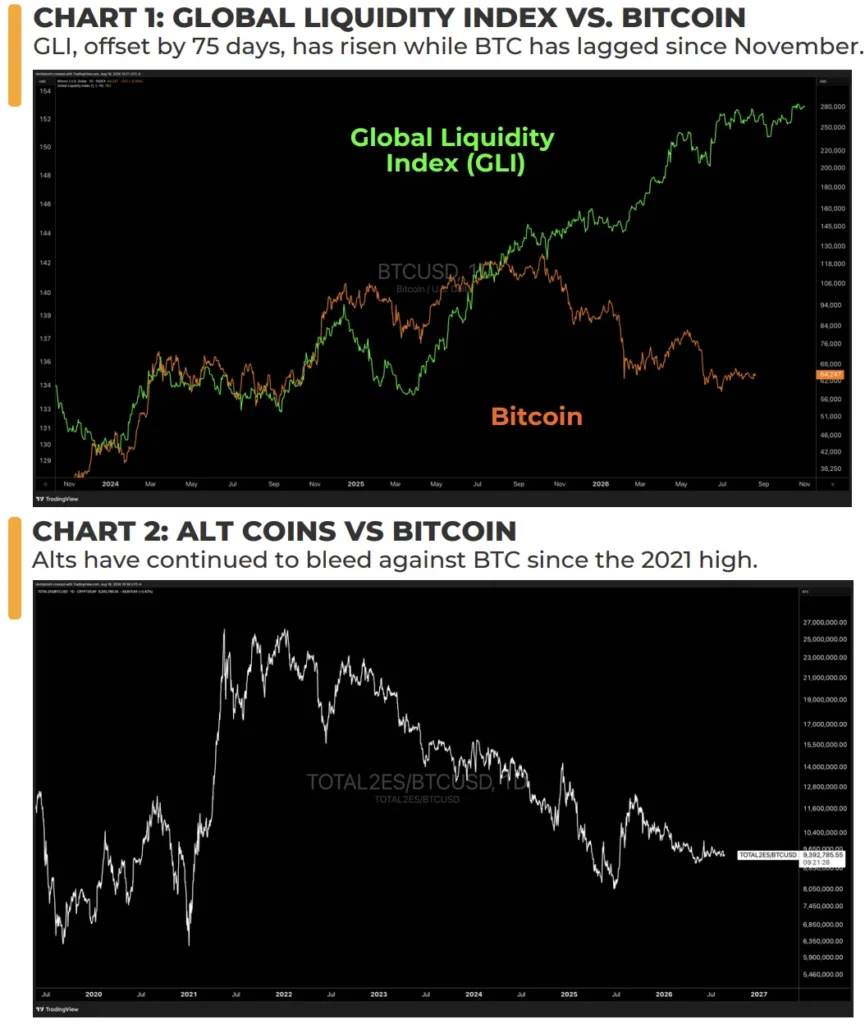
A broken transmission mechanism between global liquidity and Bitcoin would mean that rising global liquidity is no longer translating into BTC demand as reliably as it has historically. Normally, the relationship is global liquidity ↑ → financial conditions ease → risk appetite ↑ → capital flows into crypto → BTC ↑. If liquidity is rising while BTC continues to lag, the incremental capital may instead be flowing into equities, gold, credit, or other assets, while crypto-specific flows such as ETF demand, stablecoin growth, leverage, and institutional positioning remain subdued. This could indicate either a temporary lag in BTC’s response or a more structural change in how global liquidity reaches the crypto market.
For altcoins, a broken liquidity transmission mechanism could be even more significant. Altcoins generally require a second-order flow of capital after BTC establishes a strong trend: liquidity first supports BTC, then ETH and large caps, and eventually flows into higher-beta altcoins. If BTC cannot capture the liquidity impulse, there may be little capital available for an altcoin rotation, leaving weaker assets vulnerable to continued underperformance. Conversely, if the transmission mechanism eventually reactivates, the large amount of accumulated liquidity could produce a catch-up move across BTC, ETH, and eventually altcoins, particularly if crypto-specific flows begin accelerating.