Fifteen years a believer, a year of reassessment, and where I think the next cycle goes
The Maturity of Bitcoin
When I started writing this on May 31st, Bitcoin was at $74,000. I had been a Bitcoin believer for 15 years, and a Bitcoin Maxi for much of that time. This was a very difficult piece to write, not because of the data, but because of my willingness to publish it. I made many iterations over the summer, and my own cognitive dissonance delayed its release.
As an investor, I have always strived to change my views when new information warrants it. The hardest part wasn’t changing my investment thesis; it was admitting that my view had changed. This is not a bear-market piece.
2025 was the year Bitcoin could have competed with gold. Expectations of high inflation, a global recession, and geopolitical instability favored both assets. Then flows didn’t materialize, and we ended 2025 as the only year since Bitcoin’s inception in which Bitcoin was down during a period that typically sees strong price appreciation in its four-year cycle.
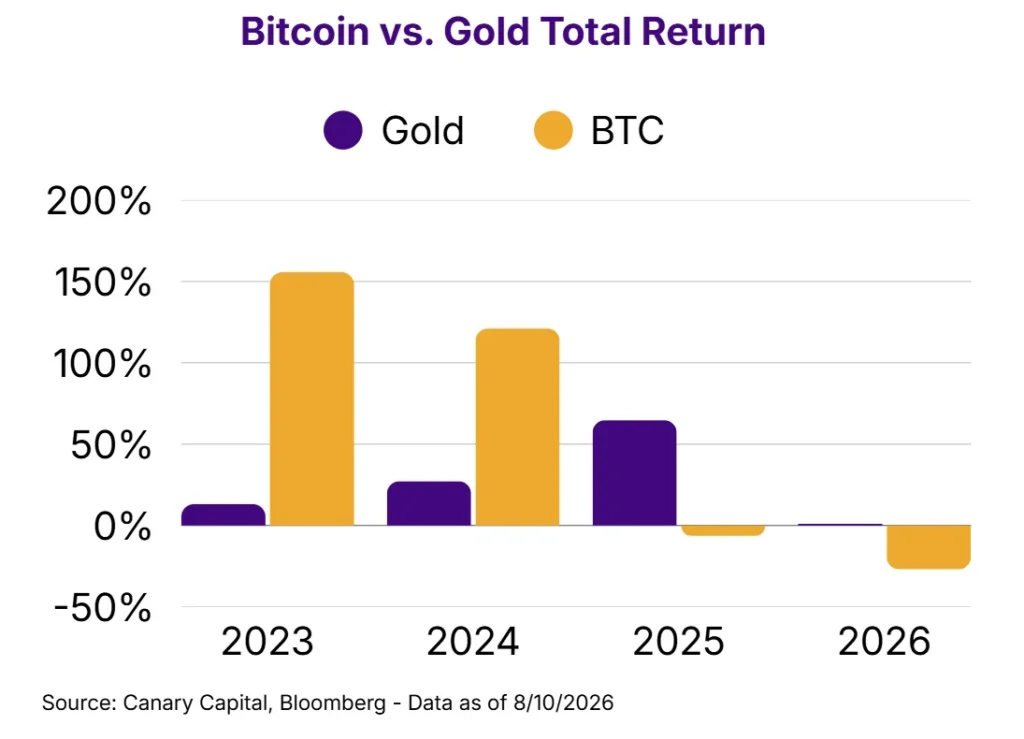
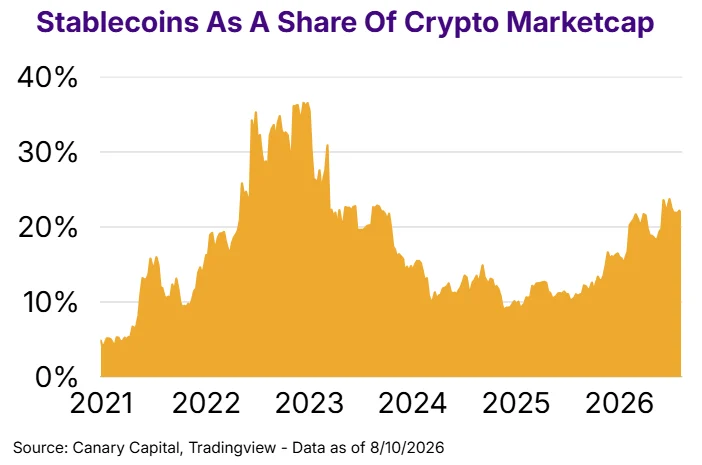
Expectations were high that Bitcoin would thrive under the crypto-friendly Trump administration. Initially, it did. But the real winners have been dollar-based stablecoins and RWAs, supported by a broader tokenization push by the entire industry. Regardless of whether the CLARITY Act passes, stablecoins will continue to thrive globally, and we will see various forms of stablecoins emerge. I believe the market will continue to focus on RWAs on-chain during this next cycle, lifting the prices of tokens for protocols that support tokenization.
Introduction to Bitcoin
When I first discovered Bitcoin, I thought about how it could live beside gold as a non-governmental standard currency. I was sitting on a bond desk and was head of Emerging Market trading and research at the time. The CIO of the company, a 320-pound amateur body builder, lumbered slowly towards me and said, “Can you take a look at Bitcoin and tell me if it might be suitable for our clients?” It was 2010, and I had heard about Bitcoin, but didn’t know much about it. I was asked because I was the only person on the desk who had a tech background, having spent a couple of years at Electronic Arts. I was often asked about new technologies like Tesla, Solar, and now digital currencies.
At first blush, I saw the potential of Bitcoin being a reasonable medium of exchange among developers, and there was a need to pay other developers in various countries for work, without being subject to expensive currency exchange rates. At the time, crypto exchanges were nonexistent for anyone outside the mailing list, and developers were the only group savvy enough to actually create wallets and mechanisms to transact between each other. Then, I looked at Bitcoin on the basis of whether it had the characteristics of sound money. It did for most aspects, and the rest could come over time. The final filter was if central banks like the Fed would allow it.
My conclusion was that the Fed, the FDIC, and the DOJ would likely attempt to kill it if it got traction. As a result, it probably wasn’t suitable for institutional investors at that time due to regulators. But it probably wouldn’t hurt to own some as a hedge in case it did take off. The Libertarian in me loved the concept.
Is Bitcoin Sound Money Today
There are multiple key characteristics that make an asset “sound” money. Now, after 17 years, here is my read on whether Bitcoin has expressed these traits successfully:
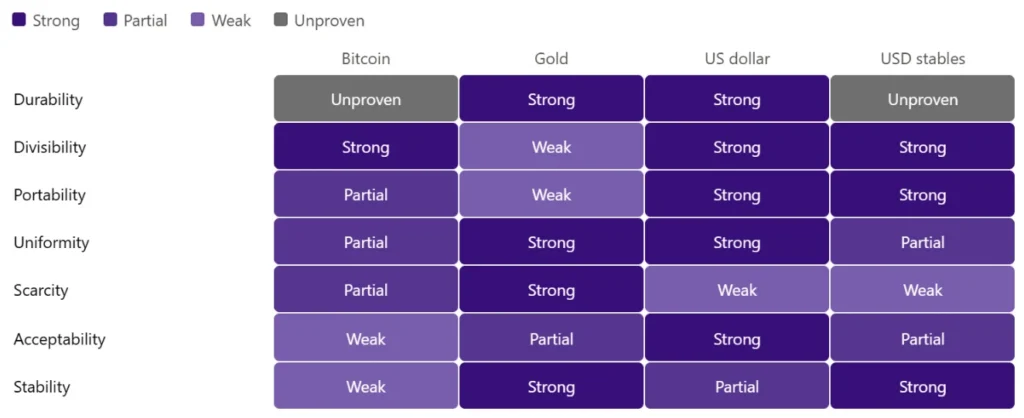
- Durability – must withstand time without deteriorating, remaining a store of value across generations.
- It is yet to be seen, as Bitcoin has only existed for 17 years, and that is only one generation. Will younger generations care? Gen X cares, but Gen Z has already moved away.
- Divisibility – must break into smaller, precise units without losing pro-rata value.
- Still intact, though as the value relative to dollars has grown, the precision offered by a satoshi – the smallest unit of Bitcoin – has shrunk substantially. This will continue to be eroded in the long-run as the dollar continues to weaken.
- Portability – must be convenient to transport, transfer, and exchange.
- There are various ways to hold, transact, and “carry” across borders. However, transaction times are extremely long versus credit cards, stablecoins, and newer distributed ledger technologies.
- Uniformity – each unit standardized and interchangeable with any other of the same value.
- While at a technical level all specific units of Bitcoin are identical, this is affected by the history of a particular coin being associated with illicit activity.
- Scarcity – supply constrained by chemistry, mining difficulty, or code, preventing dilution.
- Even though there will never be more than 21 million Bitcoin, modern financial structures such as ETFs, futures, swaps, and corporate schemes have made Bitcoin extremely leverageable. Bitcoin also does not inherently prevent rehypothecation, which synthetically creates much higher supply. This has caused multiple crashes and price instability when the leverage is unwound. Spoiler: nothing will stop that.
- Acceptability – widely recognized and accepted by the public as a medium of exchange.
- Despite Bitcoin operating successfully for 17 years, and many people having ways to own it, most of the global population will not accept it as payment. It continues to function as an asset and store of value, rather than a payment method.
- Stability – maintains purchasing power, allowing saving and long-term calculation.
- This has still not played out, and remains an experiment on whether a truly deflationary currency can achieve high price stability.
Future of Bitcoin
Regardless of the above criticisms, Bitcoin will continue to be speculated on, as speculation is one of its primary use cases. Facilitating that, ETFs give a variety of tools and capabilities that complement the qualities of Bitcoin. They:
- Provide a solution to the self-custody problem, relegating difficult custody to proficient experts and helping protect against attacks like we saw recently against Coldcard hardware wallets.
- Offer better integration into the financial planning ecosystem to be able to take advantage of tax-advantaged accounts.
- Allow a cleaner integration into a broader portfolio – one which might not be able to directly hold crypto, or, leverage it for other investments.
- Give a broader market the ability to speculate.
ETFs provide a solution to the technical complexity problem which has not had a clean, user friendly solution since the inception of Bitcoin. Correctly operating Bitcoin custody is not as simple as tapping your iPhone to pay. Coldcard hardware wallets show us how difficult this is. In 2021, a firmware error quietly weakened how the devices created their recovery phrases, and five years later someone swept over 4,000 wallets for over $100 million in Bitcoin.
The next risk event for Bitcoin
Every cycle has had its own major event exacerbating the bear market following it. In 2014, this was the collapse of Mt. Gox and the first proliferation of leveraged futures, allowing participants to short for the first time. In 2018, this was ICOs and the (near) collapse of Tether. In 2022 this was the collapse of centralized lending institutions like Celsius and the exchange FTX. 2026 is not unique: our current risk is centered on Bitcoin treasury companies.
These companies hold over 1.25 million Bitcoin, 6% of all Bitcoin ever to exist. Over the last 6 months, we have seen some of the smaller entities quietly unwind and sell their Bitcoin holdings. So far, the quantities remain a small rounding error compared to MSTR, which make up two-thirds of all holdings. This said, even MSTR is selling to fund their dividend obligations: nearly 7,000 BTC this quarter.
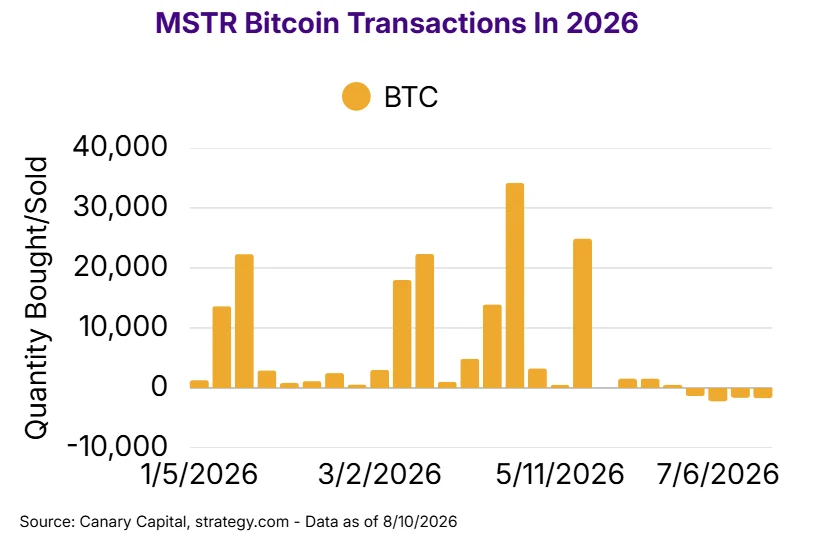
The risk is simple: A convertible bond refinancing wall is coming. With depressed mNAV and call premiums limiting their ability to raise capital, that could turn them into forced sellers to raise cash for these convertible bonds. However, the time for this to occur is running out. If they survive until a bull market, it could fix their balance sheets in time for the next cycle.
Reasons risk assets move higher
While Bitcoin has its own internal risks to navigate, its ultimate price action is still deeply tied to the broader macroeconomic environment. Central Banks are currently competing with each other on currency debasement. The primary reasons are high unemployment rates globally, the fact that many countries are in or on the verge of recession, and to fund wars. In the US, unemployment rates are holding steady despite mass layoffs due to a decrease in immigration.
A follow-on effect of lower immigration and deportations is lower rents. Though this sounds good for renters, it also means a drag on housing prices, which are already suffering from high interest rates. Despite lower rents and home prices creating a drag on inflation, energy and food have gotten much more expensive. The Iran war has pushed global oil and gas prices to levels that will likely remain for a long time, based on current oil reserves and storage capacities. These factors are keeping the Fed from lowering rates.
While there is some speculation that the Fed might actually raise rates, that would likely tank the economy. I do not believe rates will change until after midterms, then likely a Fed rate increase into the end of the year. I believe the Fed will hold rates there until there is a tipping point in consumer spending, then the Fed Funds rate will be lowered along with the balance sheet expanding by about 50%. Timing for this will be when there is a sharp decline in housing purchases, sudden increase in consumer default rates (which are already high), and most importantly, a 15%+ drop in the S&P. I expect to see the signs by the end of 2027.
Where does Bitcoin price go
The 4-year cycle is still very much in effect. This coming cycle will likely see lower volatility and muted price appreciation relative to previous cycles. One of the factors that caught the market off-guard in the last cycle was a lack of a blow off top marking a cycle ending. The 4th year of previous cycles have had the greatest price increases: 2013 BTC returns were 5,189%, 2017 were 1,368%, 2021 was 60%.
In 2025, for the first time, the 4th year showed remarkable underperformance. 2025 closed down 6%. I don’t view that year as negative, rather flat, given the rally to $126,000 in October before the market turned. Once in a bear market, the drawdowns typically last for about a year before an equilibrium is reached.
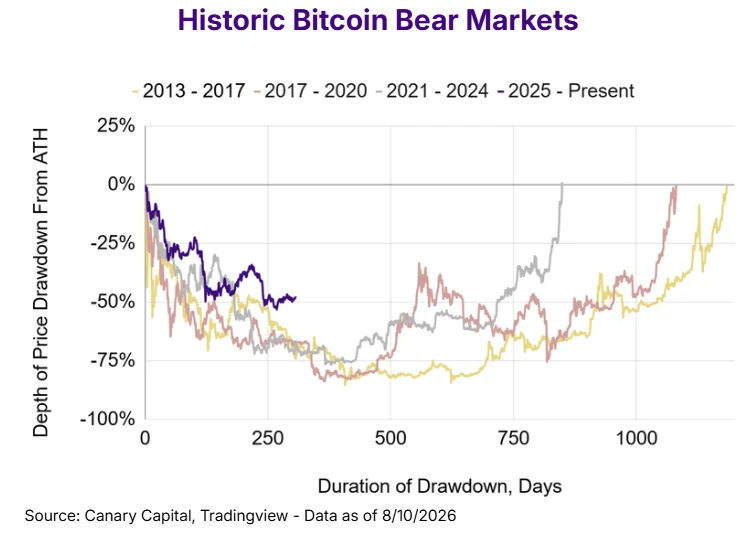
I expect 2026 to be the shortest pullback year in history. Bitcoin is currently down 27% YTD; I expect the year to end around that level or better. As for the bull market, I believe the four year cycle is still in play. I expect Bitcoin’s price to hit new all-time highs between $150,000 to $200,000 in the next cycle. While I no longer expect it to absorb gold’s market cap, it has carved out its own unique space as a necessary complement – an asset class we simply cannot ignore.