

Powell Sparks Risk Rally, Crypto Treasuries Keep Buying

August 28, 2025

Golden Opportunity

September 8, 2025

Scaling at a Cost: Cheaper Transactions, Fading Deflation

Ethereum’s long-awaited scaling vision is materializing. Layer 2 rollups, particularly Arbitrum and Optimism, are rapidly reshaping the network’s transactional landscape by offering faster, cheaper activity compared to Ethereum mainnet. But while users are enjoying lower fees and higher throughput, Ethereum’s deflationary narrative is fading in the process.

The Rise of Rollups

Since 2021, Ethereum’s roadmap has emphasized rollups as the core scaling solution. These Layer 2s batch transactions off-chain and settle them to mainnet, inheriting Ethereum’s security while offering a much smoother user experience.

The data makes the trend clear:

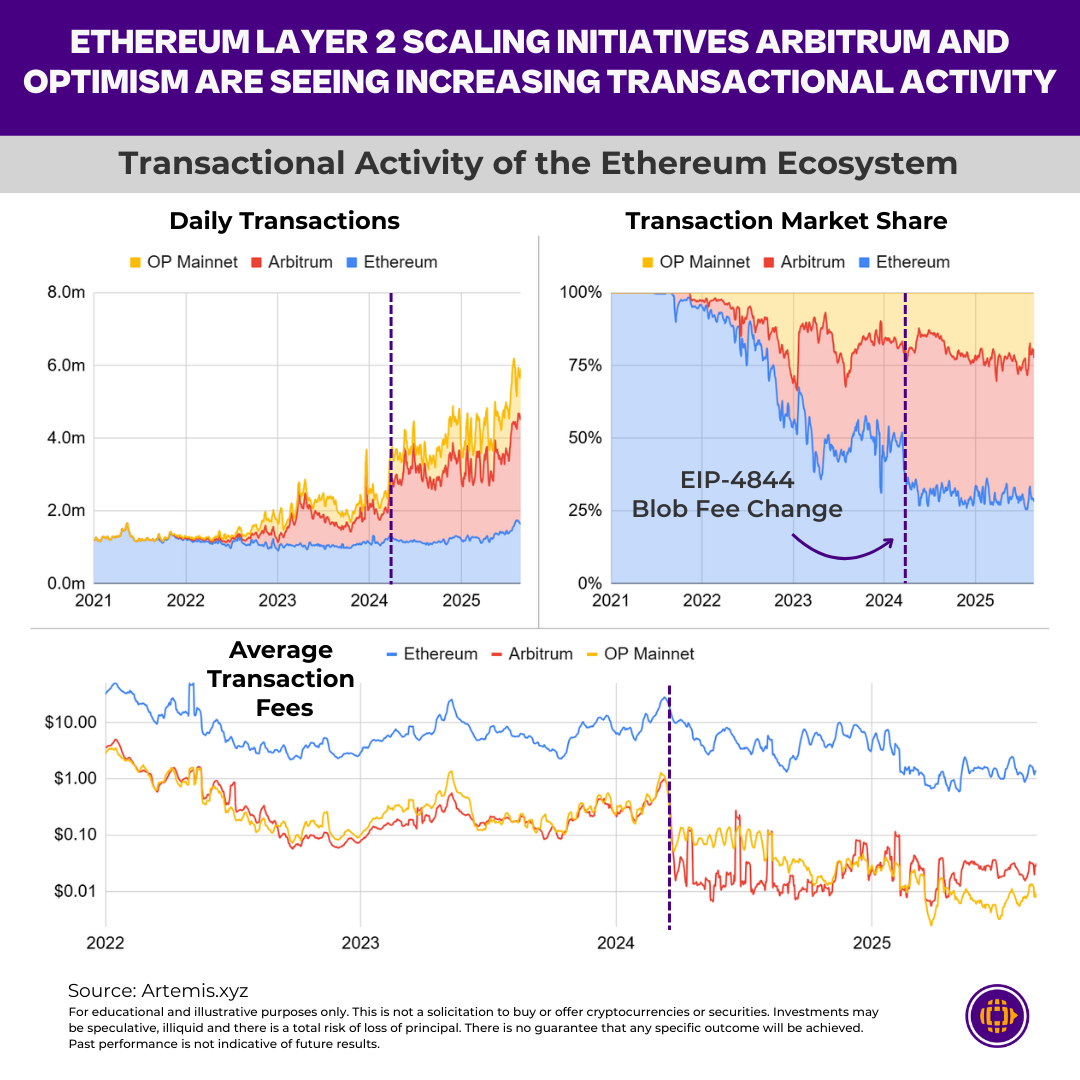
  • In 2021 and 2022, Ethereum mainnet dominated transaction share despite high gas fees.
  • By 2023, Arbitrum and Optimism began to meaningfully capture market share, as developer activity, liquidity incentives, and application growth shifted to L2s.
  • In 2024, activity accelerated after the EIP-4844 “blob fee” change, a major milestone in Ethereum’s proto-danksharding roadmap.

Today, Arbitrum and Optimism together process more daily transactions than Ethereum mainnet, a reversal that underscores just how central rollups have become.
The Impact of EIP-4844

Implemented in early 2024, EIP-4844 introduced “blob space”—a new data structure that made it drastically cheaper for rollups to publish transaction data to Ethereum. This had two immediate effects:

  1. Cheaper Transactions:
    • The average fee on rollups fell sharply to just a few cents.
    • This pricing opened the door for more high-frequency activity, from gaming to DeFi arbitrage, that was previously uneconomical.
  2. Reduced ETH Burn:
    • Ethereum’s burn mechanism (introduced by EIP-1559) depends on base fees from mainnet gas usage.
    • With more activity shifting to rollups—and blob space being priced lower than traditional calldata—ETH burn rates fell significantly.
    • As a result, Ethereum’s post-Merge deflationary momentum has slowed, raising new questions about ETH’s supply dynamics.

Scaling vs. Store-of-Value Narrative

Ethereum’s community long touted the “ultra sound money” meme, emphasizing ETH’s deflationary mechanics as a key investment case. That thesis now faces headwinds:

  • Deflationary ETH was conditional on persistently high base fees.
  • Scaling solutions, while positive for users, naturally suppress those fees.
  • The trade-off is clear: more affordable transactions, but weaker deflationary pressure.

This doesn’t undermine Ethereum’s broader value proposition as the settlement layer for a vast ecosystem of rollups, but it does shift the investment narrative from scarcity-driven supply reduction toward growth-driven demand for blockspace and staking yield.

Looking Ahead

Ethereum’s scaling roadmap is far from complete. Future upgrades—including full danksharding—will continue to expand blob capacity, driving costs lower and further entrenching rollups as the default environment for users and developers.

Key questions for investors and builders:

  • Sustainability: Can rollups sustain user growth and liquidity concentration without fragmenting activity across too many ecosystems?
  • Security Economics: With less ETH being burned, how does Ethereum’s long-term monetary policy balance staking rewards, issuance, and supply?
  • Narrative Shift: Will ETH’s role be framed less as “digital ultrasound money” and more as digital infrastructure with predictable yields?

Conclusion

Ethereum has achieved a crucial milestone in usability: transactions are cheaper, faster, and more scalable than ever before thanks to Arbitrum, Optimism, and the EIP-4844 upgrade. But this progress comes at a cost—the fading of ETH’s deflationary narrative.

As the ecosystem matures, the focus may shift away from scarcity and toward utility, adoption, and the network’s role as the settlement layer for the decentralized economy. For investors, that means reassessing the thesis: Ethereum may no longer burn supply at a rapid pace, but it is building the foundation for mass adoption.


Share


Steven McClurg

Founder, CEO

Prior to founding Canary, Steven co-founded and served as CIO of Valkyrie Investments, whose public funds business was acquired by CoinShares in 2024. He was previously a Managing Director at Guggenheim Partners, overseeing portfolio strategy for fixed income and private equity. He also founded Theseus Capital (acquired by Galaxy Digital) and served as an MD at Galaxy. Steven holds a Master of Science and MBA from Pepperdine University, where he has served as an adjunct professor.

Drew Hill

President, CLO

Drew is a seasoned digital asset attorney with deep expertise in securities law and fund compliance. Before Canary, he was GC and CCO at Valkyrie Investments and a key figure in Frost Brown Todd LLC’s Blockchain and M&A practice. He holds a BA in Finance & Spanish from the University of Oregon and a JD from Northwestern’s Pritzker School of Law.

Jamal Pesaran

Co-Chief Investment Officer

Jamal Pesaran, CFA, is Co-Chief Investment Officer for Canary Capital LLC. With 30 years of investment experience, he has extensive portfolio management, trade execution as well as client-facing experience.

As Senior Portfolio Manager with Guggenheim Partners, Jamal helped build the Guggenheim Equities business and developed the income focused and risk-managed strategies with AUM of over $4 Billion. With Morgan Stanley, as Senior PM and CIO for an Ultra High Net worth team, he managed both Active equity, fixed income strategies as well as overall portfolio allocations across alternative assets. Prior to joining Canary Capital, as Head of Capital Markets for Clifton AI, he helped develop and market a Gen-AI platform for Investment Research. His experience includes extensive portfolio management experience as Senior Equity Options Portfolio Manager, across European, US and Asian markets with Goldman Sachs and UBS Securities. He worked in Equity Derivatives Hedge Fund Sales with Lehman Brothers in New York and HSBC in Hong Kong.

He holds an MBA from UCLA Anderson where he was awarded the Edward Carter Fellowship for academic performance in the top 2% of the class.

Josh Olszewicz

VP, Head of Trading

With over a decade in digital asset markets, Josh leads Canary’s trading strategy and research. He previously headed crypto research at BraveNewCoin, was a portfolio manager at Techemy Capital, and served as Head of Research at Valkyrie Investments. Josh holds a BS in Human Biology and an MS in Biotechnology, and formerly taught lab sciences at the university level.

Linnea Steffy

VP, Finance

Linnea leads finance at Canary Capital, overseeing FP&A, fund accounting, and mid-office operations across the firm’s hedge funds, private funds, and ETFs. A strategic finance expert with a decade of experience, she previously managed over $850M+ in operating budgets at Discovery Inc., where she partnered directly with executive and creative leadership on major US networks including HGTV, DIY, and GAC. Linnea began her career at KPMG and holds a BS in Business Administration from the University of Tennessee, Knoxville.

Amber Reedy

Invetor Relations

Amber has over 15 years of experience driving growth through investor engagement, partnership strategy, and cross-sector business development. She’s known for building long-term relationships with institutional allocators and key stakeholders. Her strength lies in unlocking new revenue streams and delivering measurable outcomes across verticals.

Redding Shelby

ETF Operations Lead

Redding leads ETF operations at Canary Capital, managing daily fund activities across trading, accounting, and finance responsibilities. He is a fund operations professional with over five years of experience in ETF administration and business management. His expertise spans transaction oversight, reconciliations, and compliance for ETFs with exposure to digital assets. At U.S. Bancorp, Redding was instrumental in launching '40 Act ETF products and supporting the administrative needs of a leading national service platform. He excels at identifying and implementing process improvements, and collaborating across business units to drive performance. He holds a Bachelor of Arts in Finance from Ouachita Baptist University.

Alexis Busse

Executive Assistant

A graduate of the University of Wisconsin–Madison with a degree in Kinesiology and a certificate in Athletic Healthcare, Alexis serves as Executive Assistant and Office Manager. She brings management experience in hospitality and fitness to her role, supporting executive initiatives and overseeing daily operations to ensure organizational efficiency and seamless coordination across the company.

Dylan Farnick

Associate Trader

With over a decade of experience in digital asset markets, Dylan brings a strategic approach to trading and research. He quickly honed his skills in navigating digital exchanges and futures trading, with research focused on post-mortem analysis. His expertise extends beyond trading to include UI/UX consulting, working on trading interfaces and documentation for various platforms including Kraken and Tradingview, as well as community management, where he provided direct product feedback as a liaison with the crypto trading community.

Bronson Kaufusi

Business Development

A former NFL athlete turned business strategist, Bronson blends on-the-field experience with data-driven leadership. He brings expertise in consulting, real estate, blockchain, and data analytics, and has led initiatives supporting startups and athletic organizations alike. He serves as a board member at UVU, Head of Player Development at OG1 Athletes, and is active in nonprofit and entrepreneurial networks.