

Where Has the Liquidity Gone?

February 2, 2026

Risk-Off Shock Pushes Crypto Into Support

February 3, 2026

The Gravity of Bitcoin’s 20-WMA

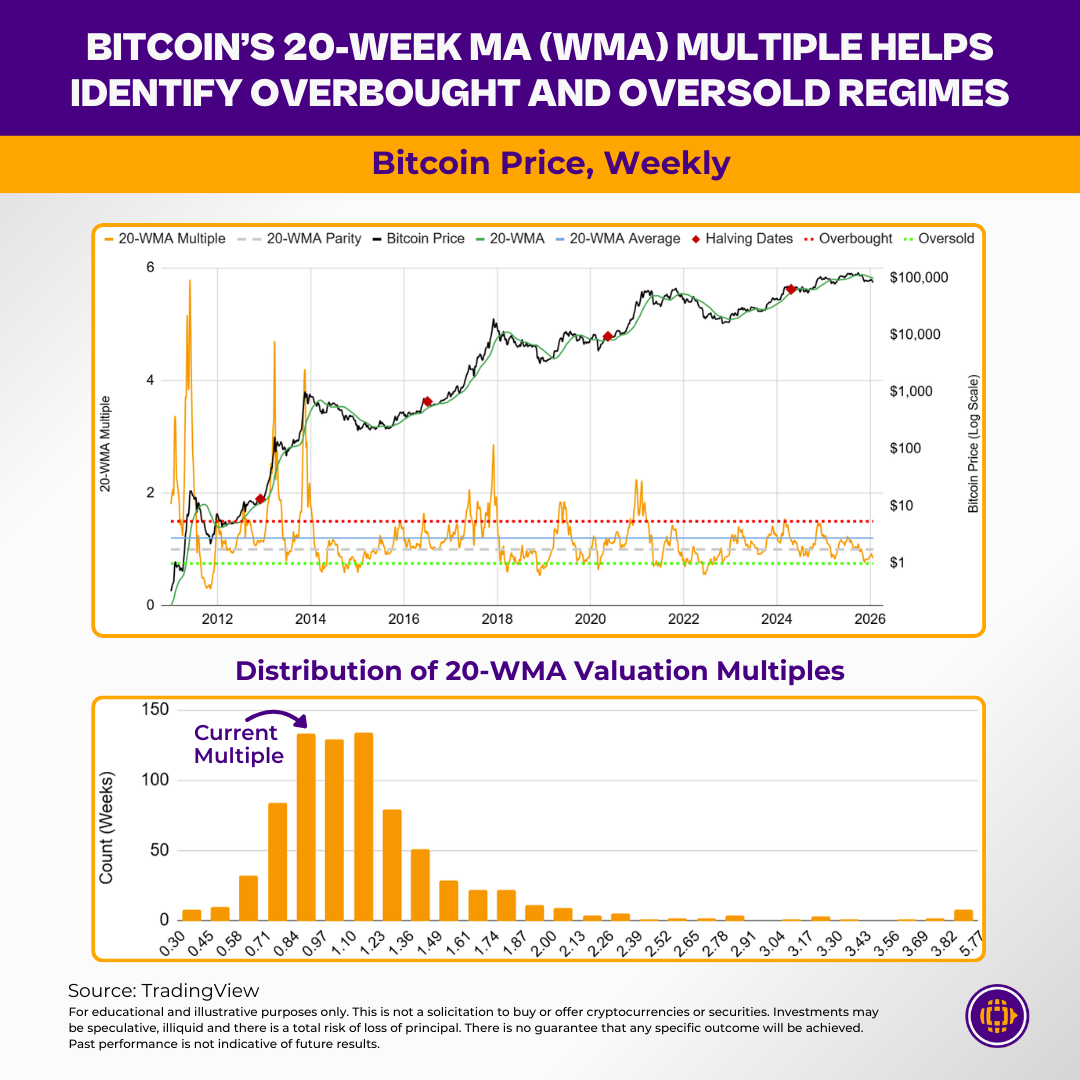
One of the most persistent features of Bitcoin’s long-term price behavior is its relationship to the 20-week weighted moving average (20-WMA). Across market cycles, this moving average has acted less like a simple trend indicator and more like a gravitational center—a level price repeatedly stretches away from during moments of euphoria or panic, only to eventually be pulled back toward.

By examining Bitcoin’s price relative to its 20-WMA, rather than price alone, we gain a clearer view of valuation extremes and regime shifts that are often obscured in nominal price charts.
Why the 20-Week WMA Matters

The 20-week timeframe captures Bitcoin’s intermediate-to-long-term trend, smoothing out short-term volatility while remaining responsive enough to reflect structural changes in market momentum. Using a weighted moving average further emphasizes recent price action, making the signal more adaptive during transitions between bull and bear phases.

Historically, the 20-WMA has served as:

  • Support during bull markets, where pullbacks often find buyers near the average
  • Resistance during bear markets, where rallies stall as price fails to reclaim it
  • A valuation anchor, toward which price repeatedly mean-reverts over time

This recurring interaction is what gives rise to the concept of gravity—price can deviate, sometimes dramatically, but it rarely escapes indefinitely.

The 20-WMA Multiple: A Valuation Lens

Rather than looking at absolute price levels, the chart above focuses on the 20-WMA multiple, calculated as:

Bitcoin Price ÷ 20-Week WMA

This framing normalizes Bitcoin’s valuation across cycles, allowing comparisons between vastly different price regimes—from early-stage adoption to today’s institutional market.

Over time, several consistent patterns emerge:

  • Overbought regimes (red zone):

    When the multiple expands meaningfully above its historical average, Bitcoin has typically been in late-cycle, momentum-driven phases. These periods have often coincided with euphoric sentiment and, historically, proximity to major cycle peaks.
  • Oversold regimes (green zone):

    When the multiple compresses below long-term norms, it has tended to mark periods of capitulation, exhaustion, or prolonged consolidation—conditions that have historically aligned with long-term accumulation opportunities.
  • Mean reversion:

    Across cycles, extreme deviations—both high and low—have eventually reverted back toward the 20-WMA, reinforcing its role as a structural equilibrium point.

What the Distribution Tells Us

The lower panel of the chart shows the distribution of historical 20-WMA multiples, offering additional context for where current conditions sit within Bitcoin’s broader history.

Most observations cluster tightly around the long-term average, while extreme readings form a thinner tail on either side. This skewed distribution underscores an important insight:

Extreme valuations are rare—and short-lived—relative to Bitcoin’s full trading history.

The current multiple, highlighted near 0.84, sits in the lower portion of the historical distribution. This does indicate oversold conditions, but it is notably not at the most extreme lows seen during prior cycle bottoms.

Interpreting the Current Regime

At a multiple of 0.84, Bitcoin appears discounted relative to its 20-week trend, suggesting downside pressure has pushed price below its structural mean. However, history suggests a distinction worth emphasizing:

  • This level reflects oversold, not deeply distressed, conditions
  • Previous generational bottoms have often required more extreme compression in the multiple
  • Mean reversion remains the dominant long-term force, but timing and path are variable

In other words, the signal points to valuation relief, not necessarily cycle completion.

Takeaway: Gravity Still Applies

Bitcoin’s long-term price behavior continues to demonstrate a powerful tendency toward mean reversion around the 20-week weighted moving average. While narratives, liquidity cycles, and macro conditions evolve, this structural relationship has remained remarkably durable.

The current 20-WMA multiple suggests Bitcoin is trading below its long-term trend, reflecting oversold conditions without signaling historical extremes. As in prior cycles, the key insight is not precision timing, but context: understanding where price sits relative to its gravitational center can help frame risk, opportunity, and regime shifts more clearly than price alone.

As always, this analysis is for educational purposes only and should be considered within a broader risk-management framework.


Share


Steven McClurg

Founder, CEO

Prior to founding Canary, Steven co-founded and served as CIO of Valkyrie Investments, whose public funds business was acquired by CoinShares in 2024. He was previously a Managing Director at Guggenheim Partners, overseeing portfolio strategy for fixed income and private equity. He also founded Theseus Capital (acquired by Galaxy Digital) and served as an MD at Galaxy. Steven holds a Master of Science and MBA from Pepperdine University, where he has served as an adjunct professor.

Drew Hill

President, CLO

Drew is a seasoned digital asset attorney with deep expertise in securities law and fund compliance. Before Canary, he was GC and CCO at Valkyrie Investments and a key figure in Frost Brown Todd LLC’s Blockchain and M&A practice. He holds a BA in Finance & Spanish from the University of Oregon and a JD from Northwestern’s Pritzker School of Law.

Jamal Pesaran

Co-Chief Investment Officer

Jamal Pesaran, CFA, is Co-Chief Investment Officer for Canary Capital LLC. With 30 years of investment experience, he has extensive portfolio management, trade execution as well as client-facing experience.

As Senior Portfolio Manager with Guggenheim Partners, Jamal helped build the Guggenheim Equities business and developed the income focused and risk-managed strategies with AUM of over $4 Billion. With Morgan Stanley, as Senior PM and CIO for an Ultra High Net worth team, he managed both Active equity, fixed income strategies as well as overall portfolio allocations across alternative assets. Prior to joining Canary Capital, as Head of Capital Markets for Clifton AI, he helped develop and market a Gen-AI platform for Investment Research. His experience includes extensive portfolio management experience as Senior Equity Options Portfolio Manager, across European, US and Asian markets with Goldman Sachs and UBS Securities. He worked in Equity Derivatives Hedge Fund Sales with Lehman Brothers in New York and HSBC in Hong Kong.

He holds an MBA from UCLA Anderson where he was awarded the Edward Carter Fellowship for academic performance in the top 2% of the class.

Josh Olszewicz

VP, Head of Trading

With over a decade in digital asset markets, Josh leads Canary’s trading strategy and research. He previously headed crypto research at BraveNewCoin, was a portfolio manager at Techemy Capital, and served as Head of Research at Valkyrie Investments. Josh holds a BS in Human Biology and an MS in Biotechnology, and formerly taught lab sciences at the university level.

Linnea Steffy

VP, Finance

Linnea leads finance at Canary Capital, overseeing FP&A, fund accounting, and mid-office operations across the firm’s hedge funds, private funds, and ETFs. A strategic finance expert with a decade of experience, she previously managed over $850M+ in operating budgets at Discovery Inc., where she partnered directly with executive and creative leadership on major US networks including HGTV, DIY, and GAC. Linnea began her career at KPMG and holds a BS in Business Administration from the University of Tennessee, Knoxville.

Amber Reedy

Invetor Relations

Amber has over 15 years of experience driving growth through investor engagement, partnership strategy, and cross-sector business development. She’s known for building long-term relationships with institutional allocators and key stakeholders. Her strength lies in unlocking new revenue streams and delivering measurable outcomes across verticals.

Redding Shelby

ETF Operations Lead

Redding leads ETF operations at Canary Capital, managing daily fund activities across trading, accounting, and finance responsibilities. He is a fund operations professional with over five years of experience in ETF administration and business management. His expertise spans transaction oversight, reconciliations, and compliance for ETFs with exposure to digital assets. At U.S. Bancorp, Redding was instrumental in launching '40 Act ETF products and supporting the administrative needs of a leading national service platform. He excels at identifying and implementing process improvements, and collaborating across business units to drive performance. He holds a Bachelor of Arts in Finance from Ouachita Baptist University.

Alexis Busse

Executive Assistant

A graduate of the University of Wisconsin–Madison with a degree in Kinesiology and a certificate in Athletic Healthcare, Alexis serves as Executive Assistant and Office Manager. She brings management experience in hospitality and fitness to her role, supporting executive initiatives and overseeing daily operations to ensure organizational efficiency and seamless coordination across the company.

Dylan Farnick

Associate Trader

With over a decade of experience in digital asset markets, Dylan brings a strategic approach to trading and research. He quickly honed his skills in navigating digital exchanges and futures trading, with research focused on post-mortem analysis. His expertise extends beyond trading to include UI/UX consulting, working on trading interfaces and documentation for various platforms including Kraken and Tradingview, as well as community management, where he provided direct product feedback as a liaison with the crypto trading community.

Bronson Kaufusi

Business Development

A former NFL athlete turned business strategist, Bronson blends on-the-field experience with data-driven leadership. He brings expertise in consulting, real estate, blockchain, and data analytics, and has led initiatives supporting startups and athletic organizations alike. He serves as a board member at UVU, Head of Player Development at OG1 Athletes, and is active in nonprofit and entrepreneurial networks.