
Exploring Litecoin’s origins, technology, tokenomics, and role as “digital silver”
The Litecoin (LTC) network launched in October 2011, created by former Google engineer Charlie Lee as a source-code fork of Bitcoin (BTC). Marketed as a “lighter” version of Bitcoin, it is often referred to as “the silver to Bitcoin’s gold.” 1
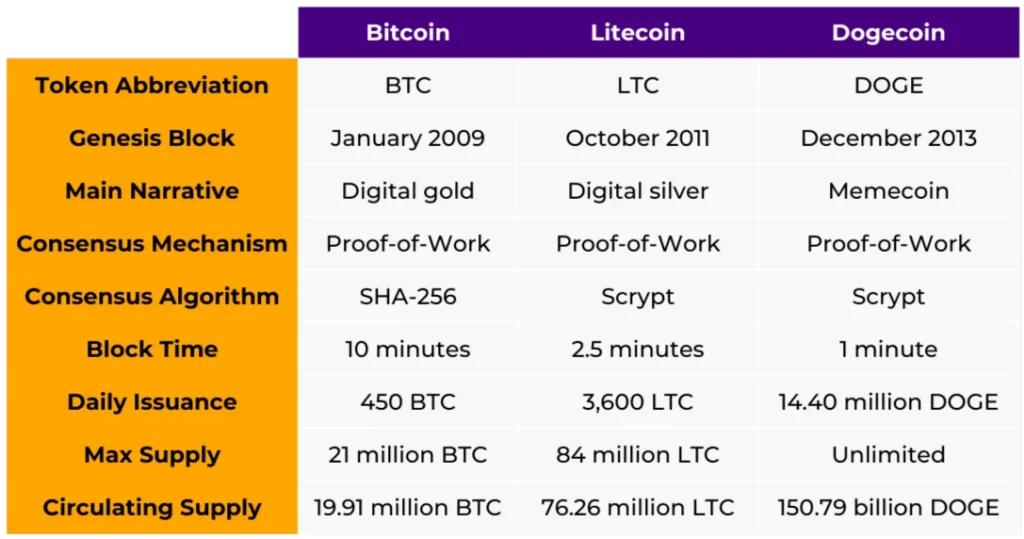
Created in October 2011 by former Google engineer Charlie Lee, Litecoin was launched as a fork of Bitcoin (BTC). While Litecoin shares many similarities with Bitcoin, it differs in several key ways: a block time of 2.5 minutes versus 10 minutes for Bitcoin, a maximum supply four times greater, and the use of the Scrypt Proof-of-Work (PoW) algorithm. 2 Since launch, the network has had zero downtime 3, offering faster settlements and lower fees, making it more practical as a medium of exchange compared to Bitcoin’s role as a store of value.
Litecoin stands out as one of the longest-surviving PoW networks. Dogecoin (DOGE), which also uses Scrypt, was merged with LTC mining after concerns about its security in 2014. This merged mining solution continues today, securing both networks.
The Litecoin network has also acted as a live proving ground for key innovations now available on both BTC and LTC: Segregated Witness (SegWit) and the Lightning Network (LN). 5
SegWit separates digital signatures from transaction data, which reduces transaction size and fixes transaction malleability. This allows for more transactions per block and enables upgrades like the Lightning Network. SegWit was activated on Litecoin in May 2017 and on Bitcoin in August 2017.
The LN is a second-layer protocol that enables instant, low-fee payments by opening payment channels between users. 6 Transactions settle off-chain, with only the final balance recorded on the main blockchain for security. Shortly after SegWit activation, Litecoin developers launched LN implementations on LTC’s mainnet. The first-ever Lightning transaction across blockchains was completed in May 2017, routing LTC to BTC. 7 Bitcoin’s LN took longer to mature, with real traction picking up in 2018–2019. 8
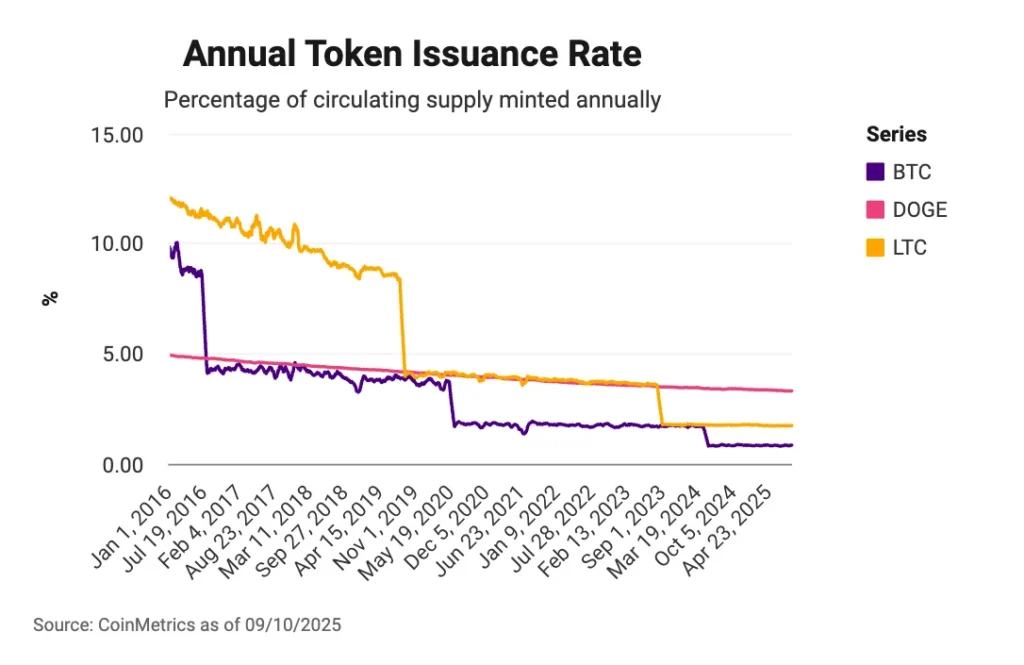
From a supply perspective, 90.82% of the 84 million LTC supply has already been mined. Annual inflation stands at 1.80% and will fall to 0.90% after the next halving in July 2027. The network currently supports about 917 public nodes worldwide, with concentrations in the U.S., Germany, and France.
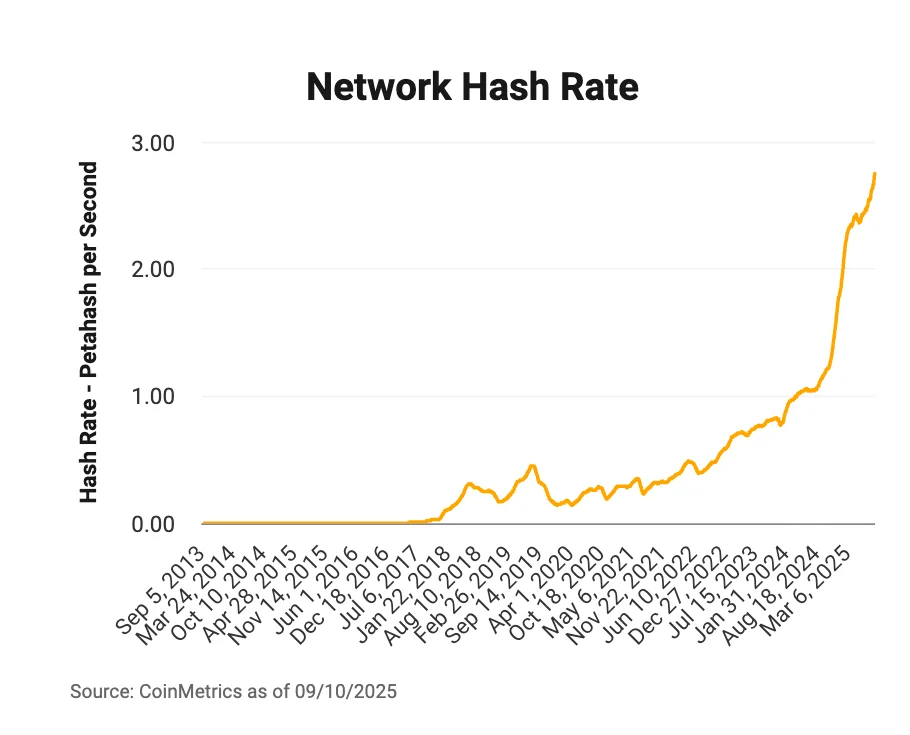
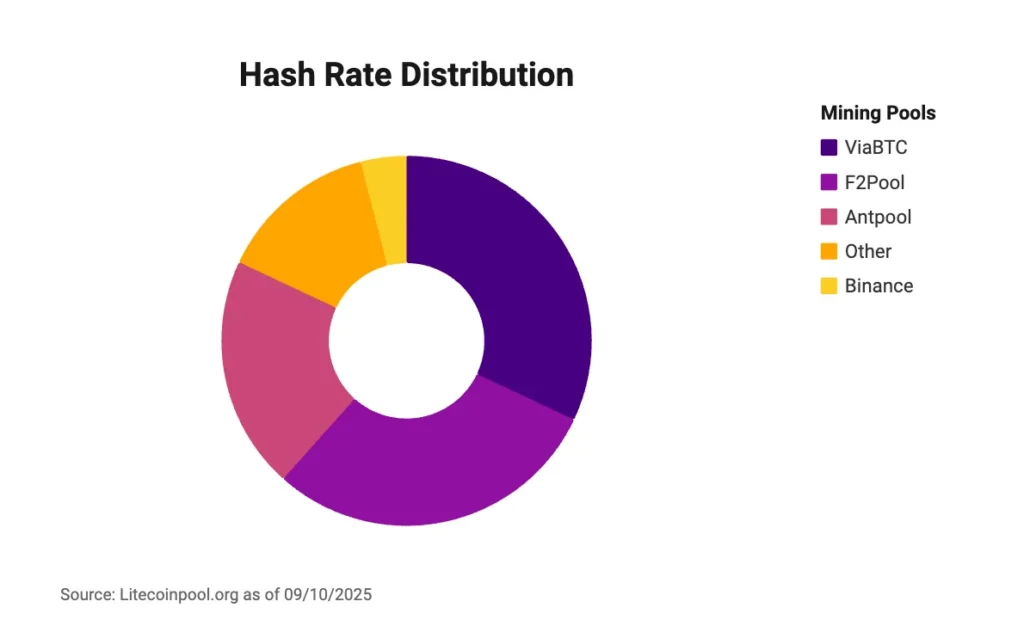
Hash rate on the network, or the total compute power working to solve the PoW algorithm for a reward, has continued to increase since 2022. More recently, thanks in large part to DOGE mining rewards, as well as increasing efficiencies in Scrypt application specific integrated circuits (ASICs), the hash rate on both networks has moved higher in a parabolic fashion. Over 80% of the hash rate is currently split between three mining pools, ViaBTC, F2Pool and Antpool, with the remainder of the hash rate dispersed among other pools and unknown users.
A mining pool is a coordinated group of PoW miners who combine their computational resources to increase the probability of successfully mining a block. Instead of each miner working in isolation (with very low odds of finding a block), participants share work and split rewards according to contributed hash power. Individual miners can easily redirect their hash power to another pool in minutes by changing configuration settings. Overall, network security depends on the distribution of actual hash power owners, not the branding of pools.
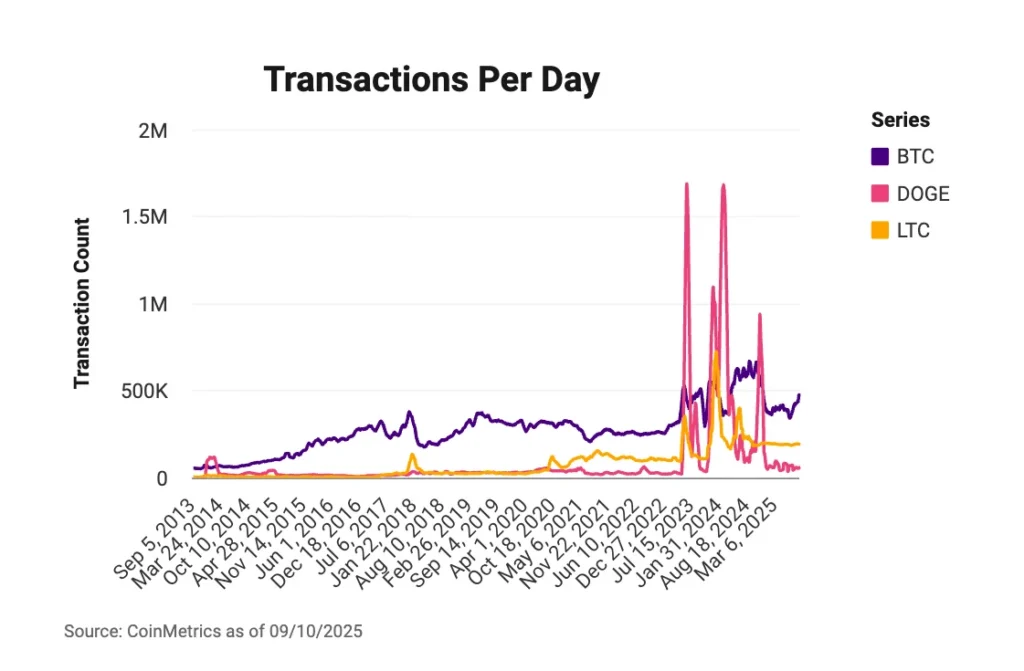
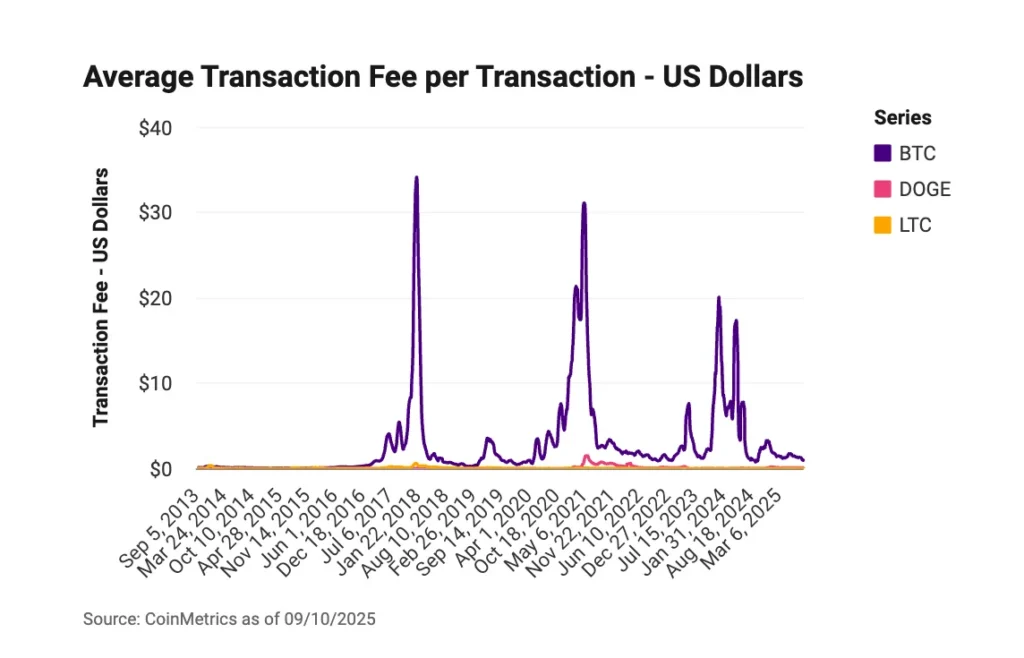
Network activity has shown gradual growth over time. Transaction counts rose sharply during Bitcoin congestion in late 2017, again in 2020 with the launch of the LiteBringer game, and more recently during periods of LTC and DOGE price volatility. Over the past few months, transactions on BTC, LTC and DOGE have declined, a development most notably evident on DOGE. Fees remain consistently low, averaging under $0.10 since 2018 and cheaper than BTC and DOGE since 2021.
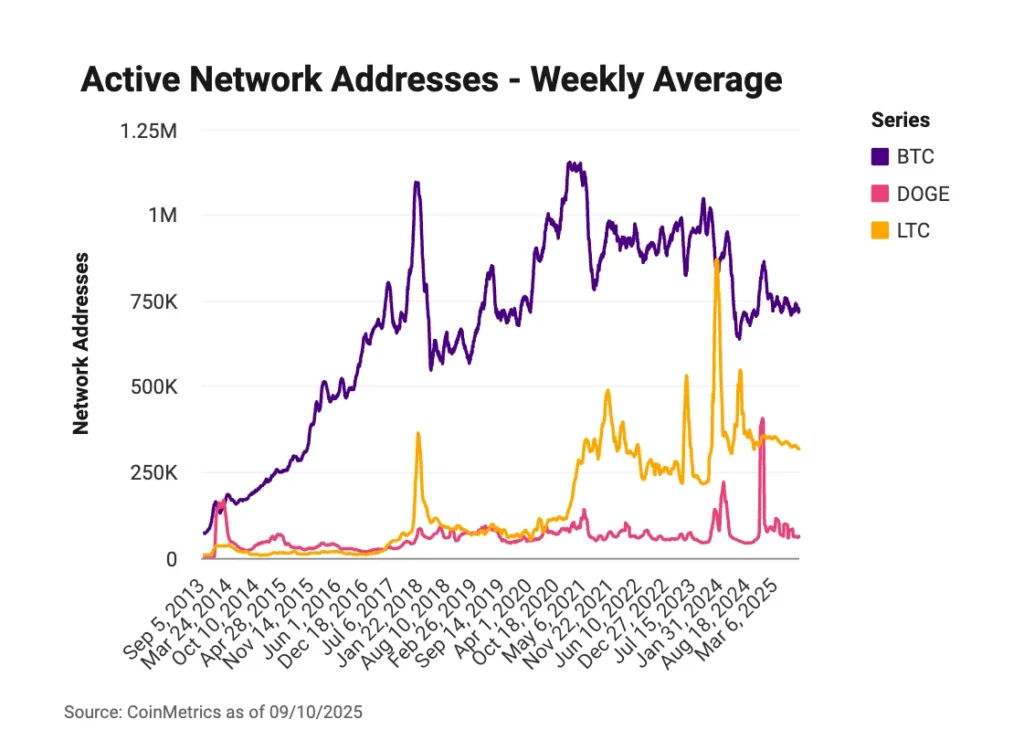
Active and unique addresses are key metrics for assessing a network’s fundamental value under Metcalfe’s Law, which holds that a network’s value is proportional to the square of its connected users (n²). Daily active addresses (DAAs), which measure the number of unique wallet addresses that are active on a blockchain within a 24-hour period, have steadily increased, especially compared to DOGE, suggesting stronger relative utility. However, activity growth in 2024 has softened across LTC, BTC, and DOGE.
Two other crypto native valuation metrics include the network value to estimated on-chain daily transactions (NVT) ratio and the market capitalization divided by the realized capitalization (MVRV) ratio.
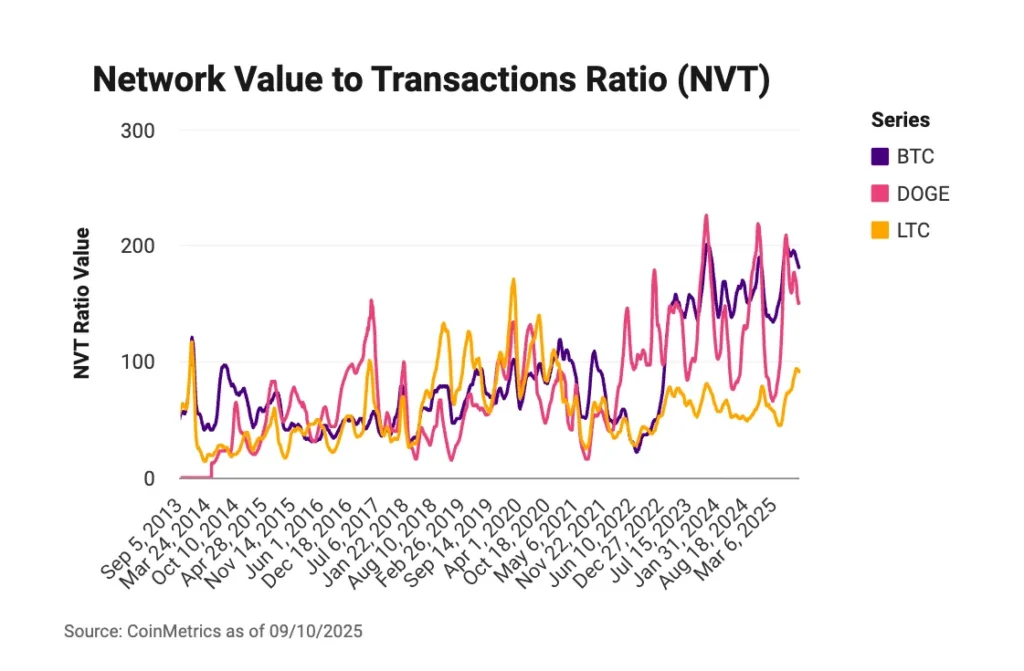
The NVT ratio compares a network’s market capitalization to its daily transaction volume, similar to how the price-to-earnings (P/E) ratio is used in equities. It measures how much value the market assigns to a blockchain relative to the amount of value being transferred through it. A high NVT may indicate the network is overvalued compared to its usage, while a low NVT suggests stronger transaction activity relative to market cap.
Inflection points in NVT can be leading indicators of a reversal in an asset’s value. An uptrend in NVT often suggests an asset is overvalued based on its economic activity and utility, which should be seen as a bearish price indicator, whereas a downtrend in NVT suggests the opposite. The LTC NVT ratio sits below 100, more favorable than BTC (~200) or DOGE (~150).
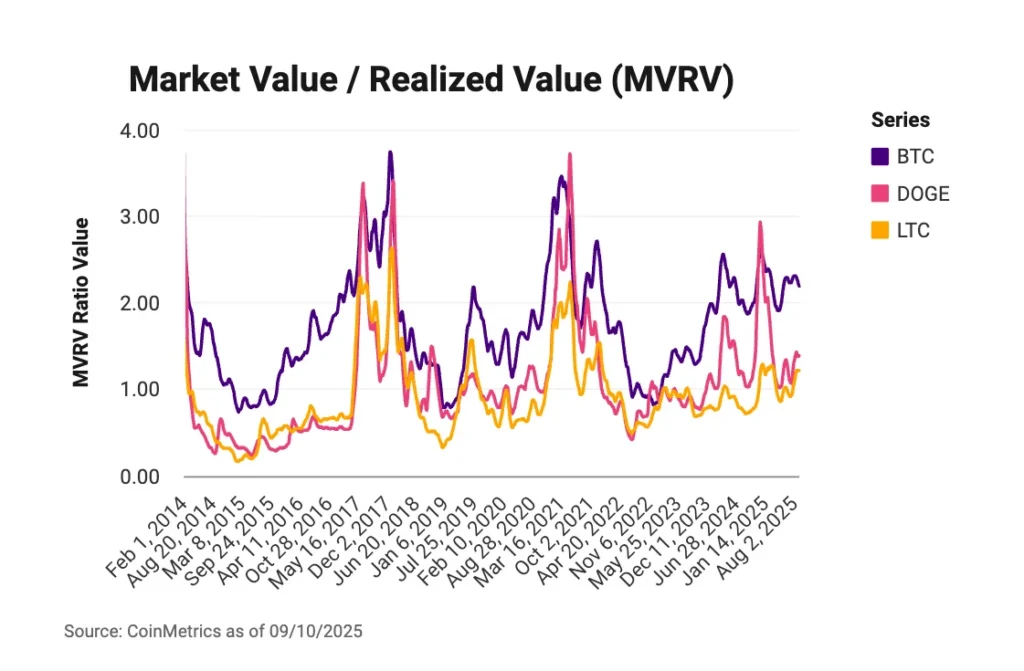
The MVRV ratio compares a network’s current market capitalization (based on the latest trading price) to its realized capitalization (the value of all coins at the price when they last moved on-chain). This ratio helps assess whether a cryptocurrency is overvalued or undervalued relative to the cost basis of its holders. A high MVRV often signals that investors are sitting on large unrealized gains, which can precede profit-taking and market corrections, while a low MVRV suggests coins are trading closer to or below their holders’ cost basis, potentially indicating undervaluation or accumulation opportunities.
Historically, periods of an MVRV less than 0.5 have represented oversold conditions, whereas periods of an MVRV greater than 2.5 have represented overbought conditions. Both instances of MVRV above 2.0 have represented all-time highs in price. Currently, MVRV is 1.25, , historically low compared to previous bull market levels above 2.00. The MVRV for BTC and DOGE currently sit higher, at 2.00 and near 1.50, respectively.
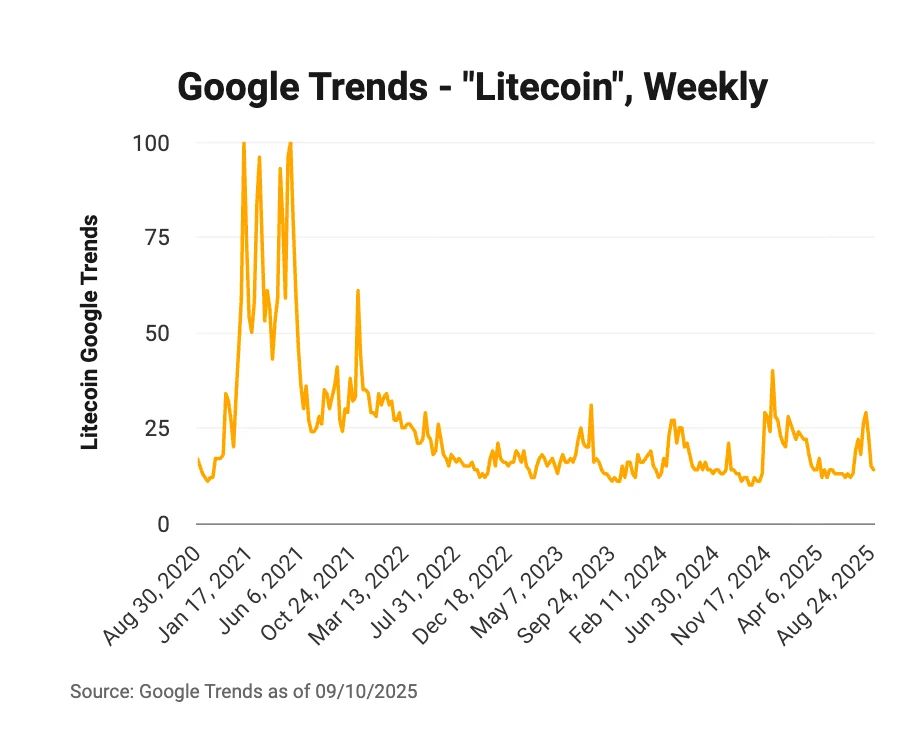
Another useful sentiment metric for cryptocurrencies is Google Trends, which measures search activity of a given subject. Sudden rises or spikes in Google trends often correspond with rises in price and correlate with trading volumes. Divergences in search vs price action can also suggest pending price activity, both up and down.
Worldwide Google Trends data for the term “litecoin” reveals significant search activity in the first half of 2021, corresponding to a rise in price at that time. Over the past few years, searches have remained subdued and currently sit near multi-year lows, hinting at minimal retail interest in the project currently.
Conclusion
Litecoin remains one of the most enduring PoW networks, combining proven security, low fees, and steady adoption. It has consistently acted as both a complement to Bitcoin and a proving ground for new blockchain technologies. Onchain metrics and valuation ratios also suggest LTC is currently undervalued, although relatively weak retail interest highlights the challenge it faces in reclaiming relevance in today’s rapidly evolving digital asset landscape.
Risks & Disclosures
Litecoin is subject to unique and substantial risks, including significant price volatility and lack of liquidity and theft. Litecoin is subject to rapid price swings, including as a result of actions and statements by influencers and the media, changes in the supply of and demand for digital assets, and other factors. There is no guarantee that Litecoin will maintain its value over the long-term.
The statements, views, and opinions expressed herein are those of the Canary Capital Group LLC. The information presented is derived from sources the Firm believes to be reliable; however, the Firm makes no representation or warranty as to the accuracy, completeness, or timeliness of such information. The digital asset landscape is rapidly evolving, and information provided may change over time without notice.
Sources
1 – https://www.gemini.com/cryptopedia/litecoin-vs-bitcoin-blockchain
3 – https://www.litecoinuptime.com/
4 – https://www.viabtc.com/en/blog/merged-mining-doge-ltc-how-it-works-and-benefits-442
5 – https://bitcoinmagazine.com/technical/litecoin-has-now-deployed-segregated-witness
6 – https://medium.com/blockchain/the-lightning-network-explained-f3982356f87e
7 – https://blog.lightning.engineering/announcement/2017/11/16/ln-swap.html