Network Overview
Tron is a high-throughput, low-cost Layer-1 blockchain network designed to facilitate the creation and distribution of digital content, financial applications, and tokenized assets. Launched in 2018, Tron has evolved from a media-focused blockchain project into one of the largest transaction networks in the digital asset ecosystem.
Today, Tron serves as a major settlement layer for stablecoins, particularly USDT, and processes billions of dollars in value transfer daily. The network has established a strong presence in emerging markets where low transaction costs and rapid settlement times are critical for payments, remittances, and digital commerce.
As of 2025, Tron consistently ranks among the most actively used public blockchains by daily transactions and active addresses. While Ethereum remains the dominant smart contract platform by total value secured and developer activity, Tron has successfully positioned itself as a leading network for stablecoin settlement and value transfer.
The network’s core value proposition centers on three attributes; fast transaction finality, low transaction costs, and high network throughput. These characteristics have made Tron particularly attractive for users conducting frequent transfers and institutions seeking efficient blockchain-based payment infrastructure.
Founders, Goals and Network Architecture
Founding Team
Tron was founded by Justin Sun in 2017 through the establishment of the Tron Foundation. Prior to launching Tron, Sun gained recognition within the cryptocurrency industry as an entrepreneur and advocate for blockchain adoption in Asia. The project initially launched as an ERC-20 token on Ethereum before migrating to its own independent blockchain through the Tron Mainnet launch in 2018.
Original Vision
Tron’s original mission focused on creating a decentralized internet where content creators could distribute digital media directly to consumers without relying on centralized platforms. The project sought to reduce the influence of large technology intermediaries by enabling peer-to-peer ownership and distribution of digital content.
Over time, however, the network’s primary use cases evolved significantly beyond content distribution. Today, Tron is more commonly associated with stablecoin transfers, decentralized finance (DeFi), cross-border payments, asset tokenization and consumer financial applications.
Strategic Positioning
Unlike many blockchain networks that prioritize maximum decentralization or cutting-edge programmability, Tron has historically emphasized scalability, transaction efficiency, and user experience. This positioning has enabled the network to capture significant transaction volume, particularly in regions where transaction costs represent a meaningful barrier to blockchain adoption.
Network Consensus
Tron utilizes a Delegated Proof-of-Stake (DPoS) consensus mechanism. Under this system, TRX token holders vote for a group of network validators known as Super Representatives (SRs). These elected participants are responsible for producing blocks, validating transactions, and maintaining network operations.
How DPoS Works on Tron
The network elects 27 Super Representatives that actively participate in block production.
The process generally follows three steps:
- TRX holders stake tokens and receive voting power.
- Token holders vote for validator candidates.
- The top 27 candidates become Super Representatives and produce blocks.
Block production occurs rapidly, enabling Tron to achieve transaction confirmation times significantly faster than many first-generation blockchain networks. The network’s voting mechanism also gives participants voting power that contributes to protocol governance, allowing them to play a role in decisions affecting the network’s development and operation.
Advantages
The DPoS model provides several benefits; high transaction throughput, low network latency, minimal transaction fees, and energy efficiency relative to Proof-of-Work systems. DPoS also enables a relatively predictable and efficient transaction-processing environment, which is particularly well suited to TRON’s high-volume stablecoin transfer activity. By delegating block production to a limited number of elected validators, the network can achieve faster confirmation times and lower computational requirements than more resource-intensive consensus mechanisms.
Trade-Offs
The primary criticism of DPoS systems is that they typically sacrifice some degree of decentralization in exchange for efficiency. Because only a limited number of validators participate in consensus, governance power can become concentrated among large stakeholders and influential ecosystem participants. The network prioritizes scalability and user experience over maximizing validator participation.
Token Supply
TRX Token Overview
TRX is the native asset of the Tron blockchain and serves several critical functions within the ecosystem. The token is used for; transaction fee payments, staking and governance participation, validator voting, resource allocation, and DeFi collateral and liquidity provisioning.
Supply Dynamics
Unlike Bitcoin’s fixed supply model, Tron operates with a more flexible token economic structure. A significant portion of network fees and resources are tied to staking mechanics, where users lock TRX to receive bandwidth and energy resources required for blockchain operations. Over time, Tron has implemented token-burning mechanisms that can offset new issuance and influence overall supply growth.
Economic Utility
The utility of TRX is closely tied to network activity. As transaction volume increases, demand for staking resources and governance participation may increase as well. This creates a relationship between network usage and token demand, although market performance is also influenced by broader cryptocurrency market conditions.
Network Architecture
Layer-1 Blockchain
Tron operates as a standalone Layer-1 blockchain with its own consensus mechanism, validator set, and execution environment. The architecture is designed to support; smart contracts, token issuance, decentralized applications, and digital asset transfers
Three-Layer Design
The Tron ecosystem can be broadly described through three architectural layers.
- Storage Layer
The storage layer manages blockchain data, account states, transaction records, and smart contract information. This layer is optimized to support high transaction throughput while maintaining network integrity and accessibility.
- Core Layer
The core layer contains the consensus mechanism, account management system, and smart contract execution environment. It is responsible for validating transactions, processing network operations, and maintaining synchronization among validators.
- Application Layer
The application layer enables developers to build decentralized applications and issue digital assets. Developers can create; decentralized exchanges (DEXs), lending protocols, gaming applications, payment solutions, and stablecoin infrastructure
Virtual Machine Compatibility
Tron supports smart contract functionality through the Tron Virtual Machine (TVM), which was designed with compatibility considerations for Ethereum’s development environment. This architecture lowers barriers for developers seeking to migrate applications or deploy familiar smart contract frameworks.
Stablecoin Infrastructure
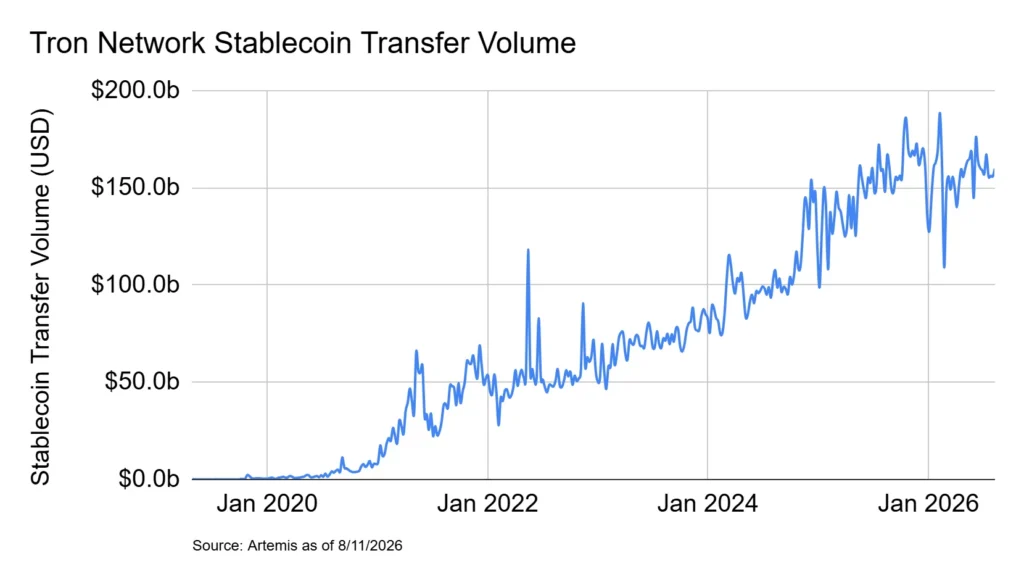
One of the most important developments within the Tron ecosystem has been its emergence as a stablecoin settlement network. A substantial share of global USDT circulation resides on Tron, making stablecoin transfers one of the network’s most significant sources of activity. This stablecoin-centric usage profile differentiates Tron from many competing smart contract platforms and has become a defining characteristic of the network’s economic model.
The Regulatory Landscape
As digital assets have grown in popularity and market size, US federal and state regulators have increased scrutiny of digital asset networks, exchanges, custodians, and users, with particular focus on investor protection, market integrity, money laundering, and illicit activity. The regulatory environment shifted following President Trump’s January 23, 2025 Executive Order, Strengthening American Leadership in Digital Financial Technology, which emphasized supporting digital asset innovation and blockchain technology and revoked several digital asset policies established under the prior administration.
Regulators
On January 21, 2025, the U.S. Securities and Exchange Commission (SEC) established its Crypto Task Force to develop a comprehensive regulatory framework for crypto assets. On March 17, 2026, the SEC and Commodity Futures Trading Commission (CFTC) jointly issued an interpretive release establishing five categories of digital assets, including “digital commodities.” The release described digital commodities as crypto assets whose value is derived from the operation of a functional crypto system and supply and demand, rather than the managerial efforts of others. This framework may provide greater clarity regarding the regulatory treatment of TRX; however, the release is interpretive rather than binding law, and there can be no assurance that regulators or courts will maintain this interpretation.
The CFTC has jurisdiction over TRX futures markets and, following its determination that TRX is a commodity under the Commodity Exchange Act, has authority to pursue fraud and manipulation involving the TRX spot market.
Impacts of Crypto Legislation
The GENIUS Act, enacted in July 2025, establishes a federal regulatory framework for payment stablecoins, including requirements related to permitted issuers, reserve assets, redemption, and supervision. The legislation could have a meaningful impact on TRON because stablecoin transfers, particularly USDT, represent a significant share of activity on the TRON Network. Clearer rules for stablecoin issuance and use could support continued growth in stablecoin settlement and demand for blockchain networks capable of processing high volumes of low-cost transactions, potentially benefiting TRON. At the same time, restrictions on permitted stablecoin issuers or changes in the availability of stablecoins on TRON could adversely affect network activity and demand for TRX.
The proposed CLARITY Act would establish a broader federal framework for digital asset market structure and clarify the respective roles of the SEC and CFTC. If enacted, clearer rules governing digital commodities and secondary-market trading could reduce regulatory uncertainty surrounding TRX and potentially facilitate greater institutional participation in the TRON ecosystem. However, the legislation remains subject to the legislative process, and its final provisions and ultimate impact on TRX remain unknown.
Network Activity
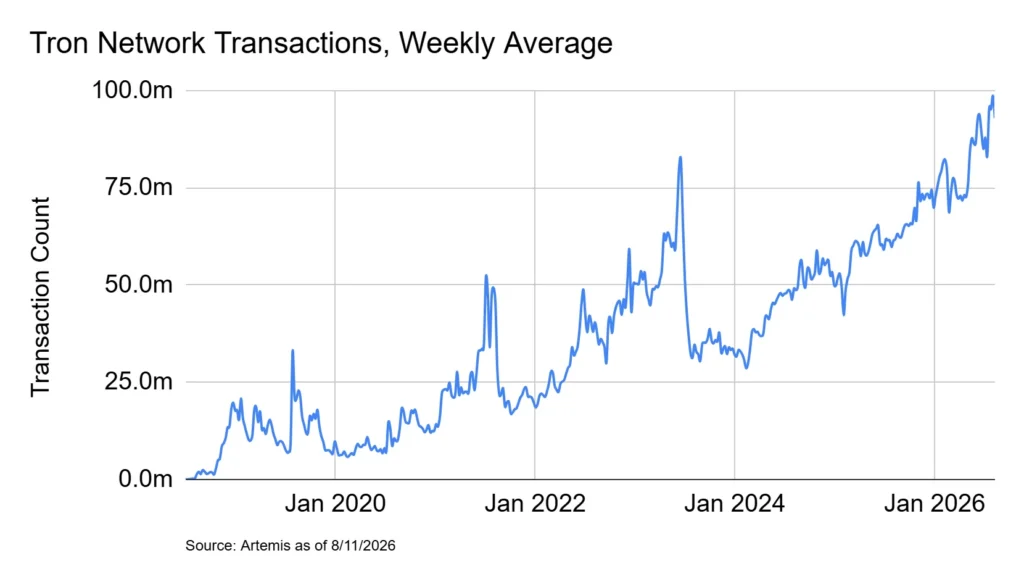
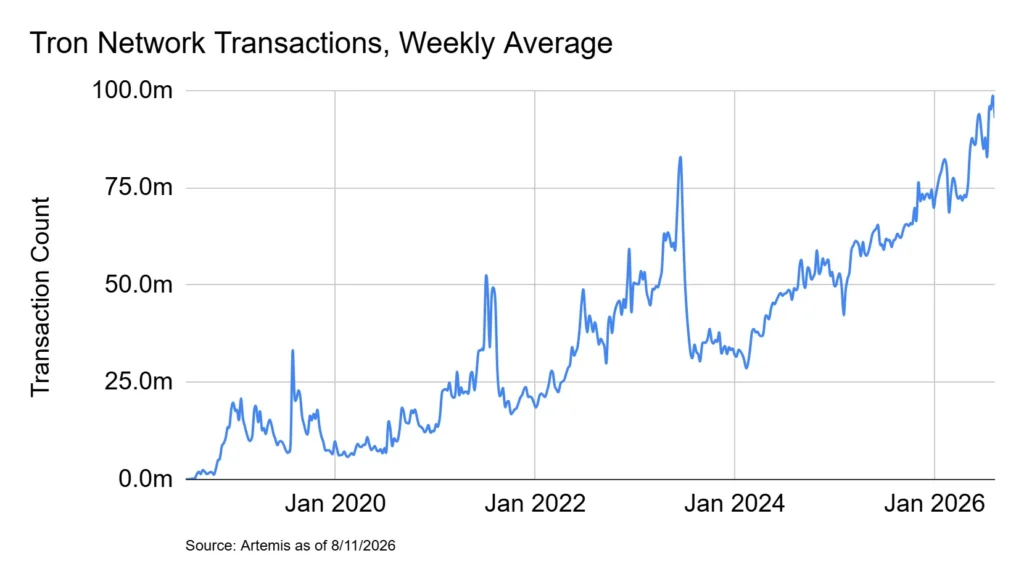
TRON has established itself as one of the most heavily utilized blockchain networks by daily transaction volume, consistently processing millions of transactions per day. Its low and relatively predictable transaction costs make the network particularly attractive for high-frequency transfers, with stablecoin activity, especially USDT, representing a significant portion of network usage. This combination of high transaction throughput and low fees has positioned TRON as an important settlement layer for digital dollars and other value-transfer applications.
Over the past several years, transactions on the tron network have continued to increase and now sit at record highs just as the average on-chain transaction fee has declined over the past few months to around $0.07, multi-year lows.
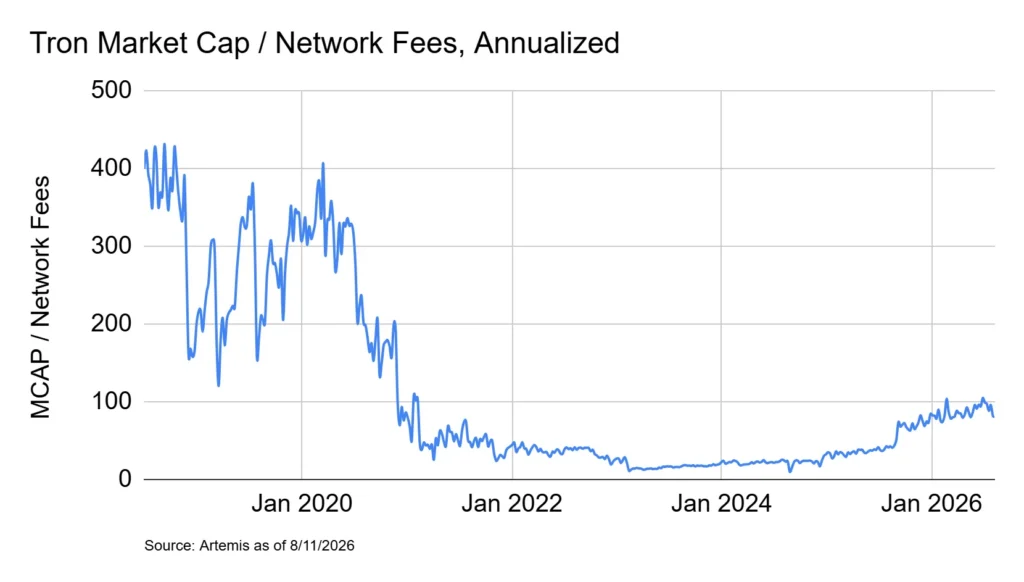
Market cap divided by fees is a valuation metric that can be understood as a crypto-native analog to the price-to-sales (P/S) ratio. This market cap should not be viewed as a predictor of future investment performance. In equities, P/S measures how much investors are paying for each dollar of a company’s revenue; here, market capitalization divided by annualized network fees shows how much the market is paying for each dollar of fee revenue generated by the Solana network. Like P/S, the multiple is driven primarily by expectations of future growth rather than current profitability. Elevated readings indicate that investors expect rapid increases in network activity, usage, or future monetization, while lower readings suggest either more modest growth expectations or that revenue is scaling faster than price.
As with early-stage or high-growth companies, this “network P/S” multiple should be interpreted with caution. Network fees are volatile, can be influenced by protocol parameters and subsidies, and do not represent revenue that directly accrues to token holders. As a result, the metric works best as a relative and directional tool rather than a valuation anchor. Compression in the ratio over time implies improving fundamentals as usage catches up to valuation, while expansion signals price appreciation running ahead of current fee generation. In practice, it is most informative when compared against the network’s own history or peer L1s and evaluated alongside adoption indicators such as transaction growth, active addresses, and fee growth rates.
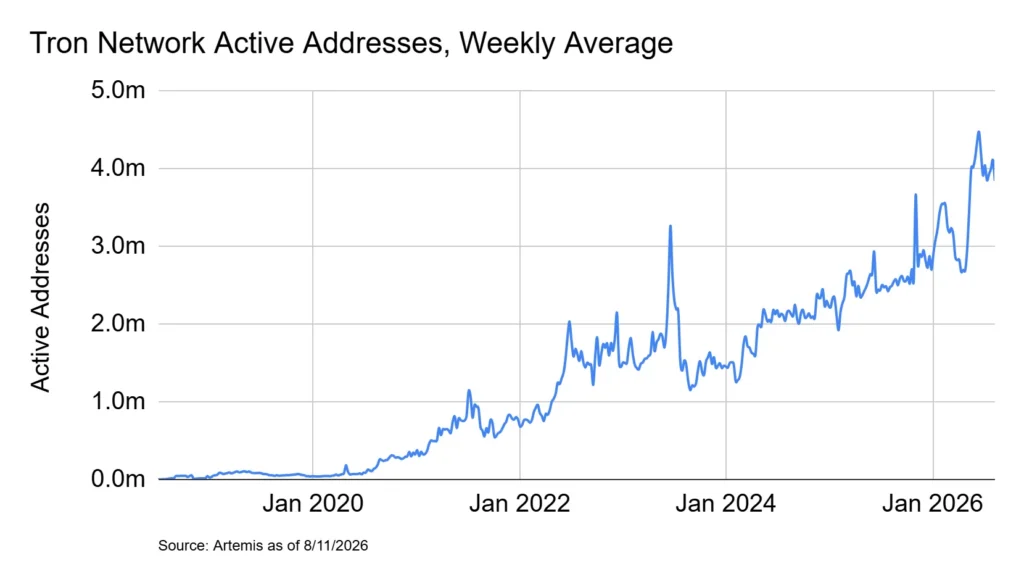
Active and unique addresses are key metrics for assessing a network’s fundamental value under Metcalfe’s Law, which holds that a network’s value is proportional to the square of its connected users (n²). Weekly active addresses (WAAs), which measure the number of unique wallet addresses that are active on a blockchain within a 7-day period, show onchain activity accelerating recently, nearing record highs. Over the past six years, Tron has seen sustained growth in network adoption and usage.
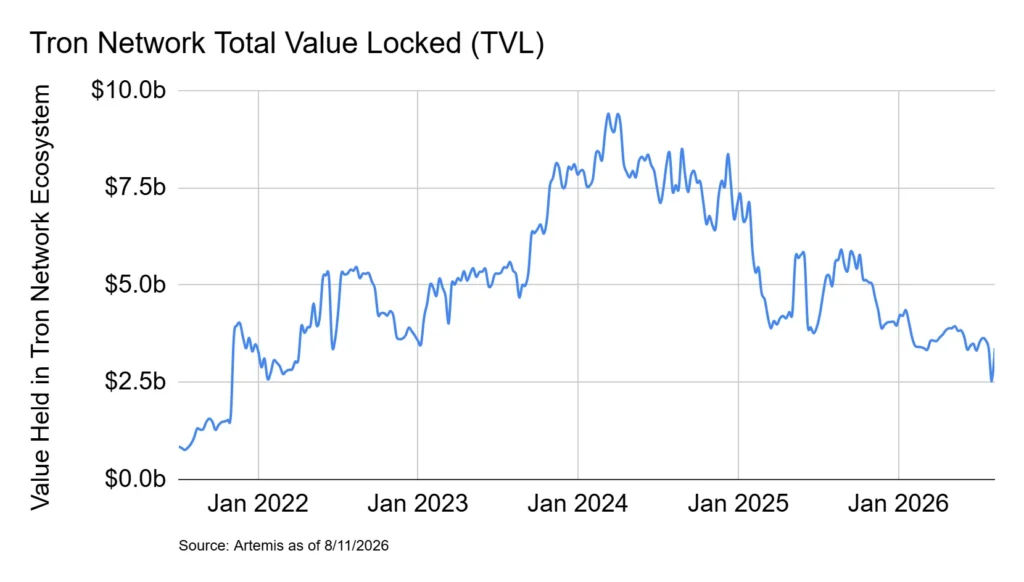
Total Value Locked (TVL) in Decentralized Finance (DeFi) is the total amount of cryptocurrency assets or USD deposited and “locked” in a protocol’s smart contracts, representing its size, liquidity, user trust, and overall health. Rising TVL suggests increased economic significance whereas falling TVL typically reflects a retrenchment in DeFi activity or a decline in underlying asset prices.
Tron’s TVL has declined materially from its 2024 peak, falling from nearly $10B to roughly $2.5B by August 2026, despite continued growth in network activity and stablecoin adoption. Tron’s declining TVL reflects weaker DeFi and lending demand rather than declining network adoption, as stablecoin liquidity and transaction activity continue to grow.
Tron: Scaling for the Future of Global Value Transfer
Tron has developed into one of the most widely utilized blockchain networks by focusing on scalability, low transaction costs, and efficient value transfer. While the project was originally conceived as a decentralized content distribution platform, its most significant success has emerged in stablecoin settlement and digital payments.
The network’s Delegated Proof-of-Stake consensus mechanism allows it to deliver high throughput and low fees, though this comes with a more concentrated validator structure than some competing blockchains. For investors, Tron represents an example of a blockchain that has prioritized practical utility and transaction efficiency over maximum decentralization.
Looking forward, Tron’s long-term investment thesis is closely tied to the continued growth of global stablecoin adoption, cross-border payment activity, and demand for low-cost blockchain settlement infrastructure. As digital asset markets mature and stablecoins become increasingly integrated into global financial systems, Tron remains well positioned as one of the industry’s most established payment-oriented blockchain networks.
Risks & Disclosures
Tron is subject to unique and substantial risks, including significant price volatility and lack of liquidity and theft. Tron is subject to rapid price swings, including as a result of actions and statements by influencers and the media, changes in the supply of and demand for digital assets, and other factors. There is no guarantee that Tron will maintain its value over the long-term.
The statements, views, and opinions expressed herein are those of the Canary Capital Group LLC. The information presented is derived from sources the Firm believes to be reliable; however, the Firm makes no representation or warranty as to the accuracy, completeness, or timeliness of such information. The digital asset landscape is rapidly evolving, and information provided may change over time without notice.
Glossary of Key Terms
Blockchain
A distributed digital ledger that records transactions across a network of computers. Blockchain technology enables secure, transparent, and tamper-resistant recordkeeping without requiring a central authority.
TRX
The native cryptocurrency of the Tron network. TRX is used for transaction fees, staking, governance participation, and accessing network resources.
Delegated Proof-of-Stake (DPoS)
Tron’s consensus mechanism, where token holders vote for a limited number of validators known as Super Representatives who are responsible for producing blocks and securing the network.
Super Representative (SR)
One of the 27 elected validators responsible for validating transactions, producing blocks, and maintaining network operations on Tron.
Staking
The process of locking TRX tokens to participate in network governance, earn rewards, and obtain network resources such as bandwidth and energy.
Smart Contract
Self-executing software that runs on a blockchain and automatically enforces predefined rules and conditions without requiring intermediaries.
Tron Virtual Machine (TVM)
The execution environment that processes smart contracts on the Tron blockchain. The TVM is designed to support efficient smart contract execution and developer compatibility.
Stablecoin
A digital asset designed to maintain a stable value, typically by being pegged to a fiat currency such as the U.S. dollar. USDT is the most widely used stablecoin on the Tron network.
USDT (Tether)
A U.S. dollar-pegged stablecoin issued by Tether. Tron has become one of the largest blockchain networks for USDT issuance and settlement.
Decentralized Finance (DeFi)
A collection of blockchain-based financial applications that provide services such as lending, borrowing, trading, and yield generation without traditional financial intermediaries.
Transaction Throughput
The number of transactions a blockchain can process within a given period. High throughput is one of Tron’s primary competitive advantages.
Network Finality
The point at which a transaction is considered irreversible and permanently recorded on the blockchain.
Validator
A network participant responsible for confirming transactions and maintaining blockchain consensus. On Tron, validators are known as Super Representatives.
Governance
The process through which network participants influence protocol decisions, upgrades, and validator selection through voting mechanisms.
Bandwidth
A network resource on Tron that allows users to perform basic transactions. Bandwidth can be obtained through staking TRX.
Energy
A computational resource required for executing smart contracts on the Tron network. Users can obtain energy by staking TRX rather than paying transaction fees directly.
Layer 1 Blockchain
A base-layer blockchain network that operates independently with its own consensus mechanism, security model, and transaction processing infrastructure. Tron is a Layer 1 blockchain.
Decentralized Application (dApp)
An application that operates on a blockchain network rather than centralized servers, often utilizing smart contracts for core functionality.
Token Burn
The permanent removal of tokens from circulation by sending them to an inaccessible address, reducing total supply over time.
Total Value Locked (TVL)
A metric commonly used in DeFi to measure the total value of assets deposited within decentralized applications and protocols on a blockchain network.