Key Takeaways
- Macro: Focus shifts away from Fed rate path to midterms, and geopolitics.
- Markets: SPY & QQQ near ATHs led by Big Tech; gold remains weak with oil volatile.
- Crypto: BTC & ETH break higher as altcoins surge, stablecoins in circulation remain flat.
Digital Asset Commentary
Rate decision uncertainty and the CLARITY Act vote are now behind the market. Looking ahead to the next FOMC meeting, markets are pricing roughly a 50/50 chance of a hike versus a hold. Attention is also turning toward the midterms, where current projections point to Democrats potentially taking back both the Senate and the House, alongside continued geopolitical risk in the Middle East. Oil remains volatile, while yields have stabilized, for now, at multi-year highs.
SPY and QQQ are a sneeze away from new all-time highs, led by Big Tech, with technicals pointing to potential moves of roughly 3% in SPY and 6% in QQQ, respectively. Despite ongoing geopolitical risk and the broader debasement narrative, gold has continued to flounder, potentially reflecting sovereign selling to fund oil purchases. A constructive GLD setup is emerging, with a close above $400 in Q4 potentially signaling a larger move.
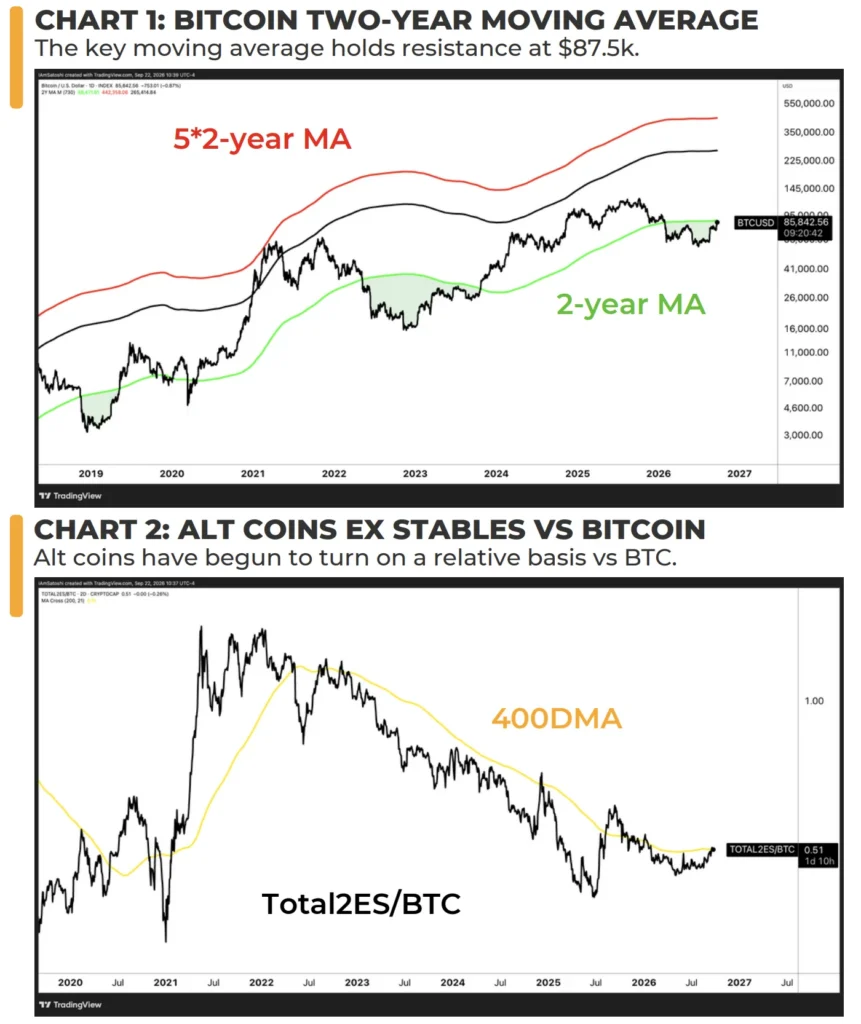
BTC and ETH broke sharply higher over the past week, with traders now focused on the psychological resistance levels of $90K and $3K, respectively. BTC is also approaching a break above its two-year moving average, a key level that has historically coincided with the beginning of multi-month bull trends.
ETH/BTC remains firmly bullish, with an inverse head-and-shoulders pattern pointing toward the 0.04 level. Higher-market-cap altcoins have also woken up across the board over the past week: SOL +16%, ZEC +30%, HYPE +20%, ADA +23%, NEAR +86%, UNI +35%, AVAX +46%, and SUI +43%.
The ALT/BTC pair may be in the process of bottoming relative to BTC, which would be a strong signal that retail speculation and animal spirits are returning to the sector. One key indicator to watch for a sustained altcoin move is the circulating supply of USDT and USDC, which has remained largely flat since Q4 last year.